To a lady playing and singing in the Morning

Joyful lady, sing!
And I will lurk here listening,
Though nought be done, and nought begun,
And work-hours swift are scurrying.

Sing, O lady, still!
Aye, I will wait each note you trill,
Though duties due that press to do
This whole day long I unfulfil.

"--It is an evening tune;
One not designed to waste the noon,"
You say. I know: time bids me go--
For daytide passes too, too soon!

But let indulgence be,
This once, to my rash ecstasy:
When sounds nowhere that carolled air
My idled morn may comfort me!

A Spot

[The Last of England, Ford Madox Brown (1852)]
.
In years defaced and lost,
Two sat here, transport-tossed,
Lit by a living love
The wilted world knew nothing of:
Scared momently
By gaingivings,
Then hoping things
That could not be.

Of love and us no trace
Abides upon the place;
The sun and shadows wheel,
Season and season sereward steal;
Foul days and fair
Here, too, prevail,
And gust and gale
As everywhere.

But lonely shepherd souls
Who bask amid these knolls
May catch a faery sound
On sleepy noontides from the ground:
"O not again
Till Earth outwears
Shall love like theirs
Suffuse this glen!"

The Collector Cleans his Picture

Fili hominis, ecce ego tollo a te desiderabile oculorum tuorom in
plaga.--EZECH. xxiv. 16.
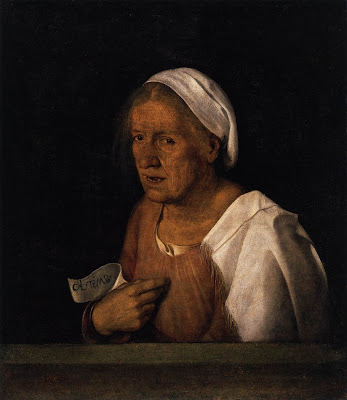
How I remember cleaning that strange picture!
I had been deep in duty for my sick neighbour -
His besides my own--over several Sundays,
Often, too, in the week; so with parish pressures,
Baptisms, burials, doctorings, conjugal counsel -
All the whatnots asked of a rural parson -
Faith, I was well-nigh broken, should have been fully
Saving for one small secret relaxation,
One that in mounting manhood had grown my hobby.

This was to delve at whiles for easel-lumber,
Stowed in the backmost slums of a soon-reached city,
Merely on chance to uncloak some worthy canvas,
Panel, or plaque, blacked blind by uncouth adventure,
Yet under all concealing a precious art-feat.
Such I had found not yet. My latest capture
Came from the rooms of a trader in ancient house-gear
Who had no scent of beauty or soul for brushcraft.
Only a tittle cost it--murked with grime-films,
Gatherings of slow years, thick-varnished over,
Never a feature manifest of man's painting.

So, one Saturday, time ticking hard on midnight
Ere an hour subserved, I set me upon it.
Long with coiled-up sleeves I cleaned and yet cleaned,
Till a first fresh spot, a high light, looked forth,
Then another, like fair flesh, and another;
Then a curve, a nostril, and next a finger,
Tapering, shapely, significantly pointing slantwise.
"Flemish?" I said. "Nay, Spanish . . . But, nay, Italian!"
- Then meseemed it the guise of the ranker Venus,
Named of some Astarte, of some Cotytto.
Down I knelt before it and kissed the panel,
Drunk with the lure of love's inhibited dreamings.

Till the dawn I rubbed, when there gazed up at me
A hag, that had slowly emerged from under my hands there,
Pointing the slanted finger towards a bosom
Eaten away of a rot from the lusts of a lifetime . . .
- I could have ended myself in heart-shook horror.
Stunned I sat till roused by a clear-voiced bell-chime,
Fresh and sweet as the dew-fleece under my luthern.
It was the matin service calling to me
From the adjacent steeple.

The Wood Fire

(A FRAGMENT)

"This is a brightsome blaze you've lit good friend, to-night!"
"--Aye, it has been the bleakest spring I have felt for years,
And nought compares with cloven logs to keep alight:
I buy them bargain-cheap of the executioners,
As I dwell near; and they wanted the crosses out of sight
By Passover, not to affront the eyes of visitors.

"Yes, they're from the crucifixions last week-ending
At Kranion. We can sometimes use the poles again,
But they get split by the nails, and 'tis quicker work than mending
To knock together new; though the uprights now and then
Serve twice when they're let stand. But if a feast's impending,
As lately, you've to tidy up for the corners' ken.

"Though only three were impaled, you may know it didn't pass off
So quietly as was wont? That Galilee carpenter's son
Who boasted he was king, incensed the rabble to scoff:
I heard the noise from my garden. This piece is the one he was on…
Yes, it blazes up well if lit with a few dry chips and shroff;
And it's worthless for much else, what with cuts and stains thereon."

The Dear

I plodded to Fairmile Hill-top, where
A maiden one fain would guard
From every hazard and every care
Advanced on the roadside sward.

I wondered how succeeding suns
Would shape her wayfarings,
And wished some Power might take such ones
Under Its warding wings.

The busy breeze came up the hill
And smartened her cheek to red,
And frizzled her hair to a haze. With a will
"Good-morning, my Dear!" I said.

She glanced from me to the far-off gray,
And, with proud severity,
"Good-morning to you--though I may say
I am not YOUR Dear," quoth she:

"For I am the Dear of one not here -
One far from his native land!" -
And she passed me by; and I did not try
To make her understand.

1901

The Fire at Tranter Sweatley's

(III of III)

There was one thing to do, and that one thing he did,
He lent her some clouts of his own,
And she took 'em perforce; and while in 'em she slid,
Tim turned to the winder, as modesty bid,
Thinking, "O that the picter my duty keeps hid
To the sight o' my eyes mid be shown!"

In the tallet he stowed her; there huddied she lay,
Shortening sleeves, legs, and tails to her limbs;
But most o' the time in a mortal bad way,
Well knowing that there'd be the divel to pay
If 'twere found that, instead o' the elements' prey,
She was living in lodgings at Tim's.

"Where's the tranter?" said men and boys; "where can er be?"
"Where's the tranter?" said Barbree alone.
"Where on e'th is the tranter?" said everybod-y:
They sifted the dust of his perished roof-tree,
And all they could find was a bone.

Then the uncle cried, "Lord, pray have mercy on me!"
And in terror began to repent.
But before 'twas complete, and till sure she was free,
Barbree drew up her loft-ladder, tight turned her key -
Tim bringing up breakfast and dinner and tea -
Till the news of her hiding got vent.

Then followed the custom-kept rout, shout, and flare
Of a skimmington-ride through the naibourhood, ere
Folk had proof o' wold Sweatley's decay.
Whereupon decent people all stood in a stare,
Saying Tim and his lodger should risk it, and pair:
So he took her to church. An' some laughing lads there
Cried to Tim, "After Sweatley!" She said, "I declare
I stand as a maiden to-day!"

Written 1866; printed 1875.

The Fire at Tranter Sweatley's

(II of III)
,
Her cwold little figure half-naked he views
Played about by the frolicsome breeze,
Her light-tripping totties, her ten little tooes,
All bare and besprinkled wi' Fall's chilly dews,
While her great gallied eyes, through her hair hanging loose,
Sheened as stars through a tardle o' trees.

She eyed en; and, as when a weir-hatch is drawn,
Her tears, penned by terror afore,
With a rushing of sobs in a shower were strawn,
Till her power to pour 'em seemed wasted and gone
From the heft o' misfortune she bore.

"O Tim, my OWN Tim I must call 'ee--I will!
All the world ha' turned round on me so!
Can you help her who loved 'ee, though acting so ill?
Can you pity her misery--feel for her still?
When worse than her body so quivering and chill
Is her heart in its winter o' woe!

"I think I mid almost ha' borne it," she said,
"Had my griefs one by one come to hand;
But O, to be slave to thik husbird for bread,
And then, upon top o' that, driven to wed,
And then, upon top o' that, burnt out o' bed,
Is more than my nater can stand!"

Tim's soul like a lion 'ithin en outsprung -
(Tim had a great soul when his feelings were wrung)--
"Feel for 'ee, dear Barbree?" he cried;
And his warm working-jacket about her he flung,
Made a back, horsed her up, till behind him she clung
Like a chiel on a gipsy, her figure uphung
By the sleeves that around her he tied.

Over piggeries, and mixens, and apples, and hay,
They lumpered straight into the night;
And finding bylong where a halter-path lay,
At dawn reached Tim's house, on'y seen on their way
By a naibour or two who were up wi' the day;
But they gathered no clue to the sight.

Then tender Tim Tankens he searched here and there
For some garment to clothe her fair skin;
But though he had breeches and waistcoats to spare,
He had nothing quite seemly for Barbree to wear,
Who, half shrammed to death, stood and cried on a chair
At the caddle she found herself in.

The Fire at Tranter Sweatley's

(I of III)
.
They had long met o' Zundays--her true love and she -
And at junketings, maypoles, and flings;
But she bode wi' a thirtover uncle, and he
Swore by noon and by night that her goodman should be
Naibour Sweatley--a gaffer oft weak at the knee
From taking o' sommat more cheerful than tea -
Who tranted, and moved people's things.

She cried, "O pray pity me!" Nought would he hear;
Then with wild rainy eyes she obeyed.
She chid when her Love was for clinking off wi' her.
The pa'son was told, as the season drew near
To throw over pu'pit the names of the peair
As fitting one flesh to be made.

The wedding-day dawned and the morning drew on;
The couple stood bridegroom and bride;
The evening was passed, and when midnight had gone
The folks horned out, "God save the King," and anon
The two home-along gloomily hied.

The lover Tim Tankens mourned heart-sick and drear
To be thus of his darling deprived:
He roamed in the dark ath'art field, mound, and mere,
And, a'most without knowing it, found himself near
The house of the tranter, and now of his Dear,
Where the lantern-light showed 'em arrived.

The bride sought her cham'er so calm and so pale
That a Northern had thought her resigned;
But to eyes that had seen her in tide-times of weal,
Like the white cloud o' smoke, the red battle-field's vail,
That look spak' of havoc behind.

The bridegroom yet laitered a beaker to drain,
Then reeled to the linhay for more,
When the candle-snoff kindled some chaff from his grain -
Flames spread, and red vlankers, wi' might and wi' main,
And round beams, thatch, and chimley-tun roar.

Young Tim away yond, rafted up by the light,
Through brimble and underwood tears,
Till he comes to the orchet, when crooping thereright
In the lewth of a codlin-tree, bivering wi' fright,
Wi' on'y her night-rail to screen her from sight,
His lonesome young Barbree appears.

Fragment

At last I entered a long dark gallery,
Catacomb-lined; and ranged at the side
Were the bodies of men from far and wide
Who, motion past, were nevertheless not dead.

"The sense of waiting here strikes strong;
Everyone's waiting, waiting, it seems to me;
What are you waiting for so long? -
What is to happen?" I said.

"O we are waiting for one called God," said they,
"(Though by some the Will, or Force, or Laws;
And, vaguely, by some, the Ultimate Cause;)
Waiting for him to see us before we are clay.
Yes; waiting, waiting, for God TO KNOW IT" . . .

"To know what?" questioned I.
"To know how things have been going on earth and below it:
It is clear he must know some day."
I thereon asked them why.

"Since he made us humble pioneers
Of himself in consciousness of Life's tears,
It needs no mighty prophecy
To tell that what he could mindlessly show
His creatures, he himself will know.

"By some still close-cowled mystery
We have reached feeling faster than he,
But he will overtake us anon,
If the world goes on."

Wives in the Sere

I
Never a careworn wife but shows,
If a joy suffuse her,
Something beautiful to those
Patient to peruse her,
Some one charm the world unknows
Precious to a muser,
Haply what, ere years were foes,
Moved her mate to choose her.

II
But, be it a hint of rose
That an instant hues her,
Or some early light or pose
Wherewith thought renews her -
Seen by him at full, ere woes
Practised to abuse her -
Sparely comes it, swiftly goes,
Time again subdues her.

I Thought, My Heart

I thought, my Heart, that you had healed
Of those sore smartings of the past,
And that the summers had oversealed
All mark of them at last.
But closely scanning in the night
I saw them standing crimson-bright
Just as she made them:
Nothing could fade them;
Yea, I can swear
That there they were -
They still were there!

Then the Vision of her who cut them came,
And looking over my shoulder said,
"I am sure you deal me all the blame
For those sharp smarts and red;
But meet me, dearest, to-morrow night,
In the churchyard at the moon's half-height,
And so strange a kiss
Shall be mine, I wis,
That you'll cease to know
If the wounds you show
Be there or no!"

Her Father

[Weymouth from Portland - October 2008]

I met her, as we had privily planned,
Where passing feet beat busily:
She whispered: "Father is at hand!
He wished to walk with me."

His presence as he joined us there
Banished our words of warmth away;
We felt, with cloudings of despair,
What Love must lose that day.

Her crimson lips remained unkissed,
Our fingers kept no tender hold,
His lack of feeling made the tryst
Embarrassed, stiff, and cold.

A cynic ghost then rose and said,
"But is his love for her so small
That, nigh to yours, it may be read
As of no worth at all?

"You love her for her pink and white;
But what when their fresh splendours close?
His love will last her in despite
Of Time, and wrack, and foes."

WEYMOUTH.

The Dead Drummer

I
They throw in Drummer Hodge, to rest
Uncoffined--just as found:
His landmark is a kopje-crest
That breaks the veldt around;
And foreign constellations west
Each night above his mound.

II
Young Hodge the Drummer never knew -
Fresh from his Wessex home -
The meaning of the broad Karoo,
The Bush, the dusty loam,
And why uprose to nightly view
Strange stars amid the gloam.

III
Yet portion of that unknown plain
Will Hodge for ever be;
His homely Northern breast and brain
Grow up a Southern tree.
And strange-eyed constellations reign
His stars eternally.

On the Belgian Expatriation

I dreamt that people from the Land of Chimes
Arrived one autumn morning with their bells,
To hoist them on the towers and citadels
Of my own country, that the musical rhymes

Rung by them into space at meted times
Amid the market's daily stir and stress,
And the night's empty star-lit silentness,
Might solace souls of this and kindred climes.

Then I awoke; and lo, before me stood
The visioned ones, but pale and full of fear;
From Bruges they came, and Antwerp, and Ostend,

No carillons in their train. Foes of mad mood
Had shattered these to shards amid the gear
Of ravaged roof, and smouldering gable-end.

October 18, 1914.

Autumn in King's Hintock Park

Here by the baring bough
Raking up leaves,
Often I ponder how
Springtime deceives, -
I, an old woman now,
Raking up leaves.

Here in the avenue
Raking up leaves,
Lords' ladies pass in view,
Until one heaves
Sighs at life's russet hue,
Raking up leaves!

Just as my shape you see
Raking up leaves,
I saw, when fresh and free,
Those memory weaves
Into grey ghosts by me,
Raking up leaves.

Yet, Dear, though one may sigh,
Raking up leaves,
New leaves will dance on high -
Earth never grieves! -
Will not, when missed am I
Raking up leaves.

1901.

Evelyn G. of Christminster

I can see the towers
In mind quite clear
Not many hours'
Faring from here;
But how up and go,
And briskly bear
Thither, and know
That are not there?

Though the birds sing small,
And apple and pear
On your trees by the wall
Are ripe and rare,
Though none excel them,
I have no care
To taste them or smell them
And you not there.

Though the College stones
Are smit with the sun,
And the graduates and Dons
Who held you as one
Of brightest brow
Still think as they did,
Why haunt with them now
Your candle is hid?

Towards the river
A pealing swells:
They cost me a quiver -
Those prayerful bells!
How go to God,
Who can reprove
With so heavy a rod
As your swift remove!

The chorded keys
Wait all in a row,
And the bellows wheeze
As long ago.
And the psalter lingers,
And organist's chair;
But where are your fingers
That once wagged there?

Shall I then seek
That desert place
This or next week,
And those tracks trace
That fill me with cark
And cloy; nowhere
Being movement or mark
Of you now there!

The Bullfinches

Bother Bulleys, let us sing
From the dawn till evening! -
For we know not that we go not
When the day's pale pinions fold
Unto those who sang of old.

When I flew to Blackmoor Vale,
Whence the green-gowned faeries hail,
Roosting near them I could hear them
Speak of queenly Nature's ways,
Means, and moods,--well known to fays.

All we creatures, nigh and far
(Said they there), the Mother's are:
Yet she never shows endeavour
To protect from warrings wild
Bird or beast she calls her child.

Busy in her handsome house
Known as Space, she falls a-drowse;
Yet, in seeming, works on dreaming,
While beneath her groping hands
Fiends make havoc in her bands.

How her hussif'ry succeeds
She unknows or she unheeds,
All things making for Death's taking!
--So the green-gowned faeries say
Living over Blackmoor way.

Come then, brethren, let us sing,
From the dawn till evening! -
For we know not that we go not
When the day's pale pinions fold
Unto those who sang of old.

Shelley's Skylark

(The neighbourhood of Leghorn: March, 1887)

Somewhere afield here something lies
In Earth's oblivious eyeless trust
That moved a poet to prophecies -
A pinch of unseen, unguarded dust

The dust of the lark that Shelley heard,
And made immortal through times to be; -
Though it only lived like another bird,
And knew not its immortality.

Lived its meek life; then, one day, fell -
A little ball of feather and bone;
And how it perished, when piped farewell,
And where it wastes, are alike unknown.

Maybe it rests in the loam I view,
Maybe it throbs in a myrtle's green,
Maybe it sleeps in the coming hue
Of a grape on the slopes of yon inland scene.

Go find it, faeries, go and find
That tiny pinch of priceless dust,
And bring a casket silver-lined,
And framed of gold that gems encrust;

And we will lay it safe therein,
And consecrate it to endless time;
For it inspired a bard to win
Ecstatic heights in thought and rhyme.

The Selfsame Song

A bird bills the selfsame song,
With never a fault in its flow,
That we listened to here those long
Long years ago.

A pleasing marvel is how
A strain of such rapturous rote
Should have gone on thus till now
Unchanged in a note!

- But it's not the selfsame bird. -
No: perished to dust is he . . .
As also are those who heard
That song with me.

Wagtail and Baby

A baby watched a ford, whereto
A wagtail came for drinking;
A blaring bull went wading through,
The wagtail showed no shrinking.

A stallion splashed his way across,
The birdie nearly sinking;
He gave his plumes a twitch and toss,
And held his own unblinking.

Next saw the baby round the spot
A mongrel slowly slinking;
The wagtail gazed, but faltered not
In dip and sip and prinking.

A perfect gentleman then neared;
The wagtail, in a winking,
With terror rose and disappeared;
The baby fell a-thinking.